Why this park matters
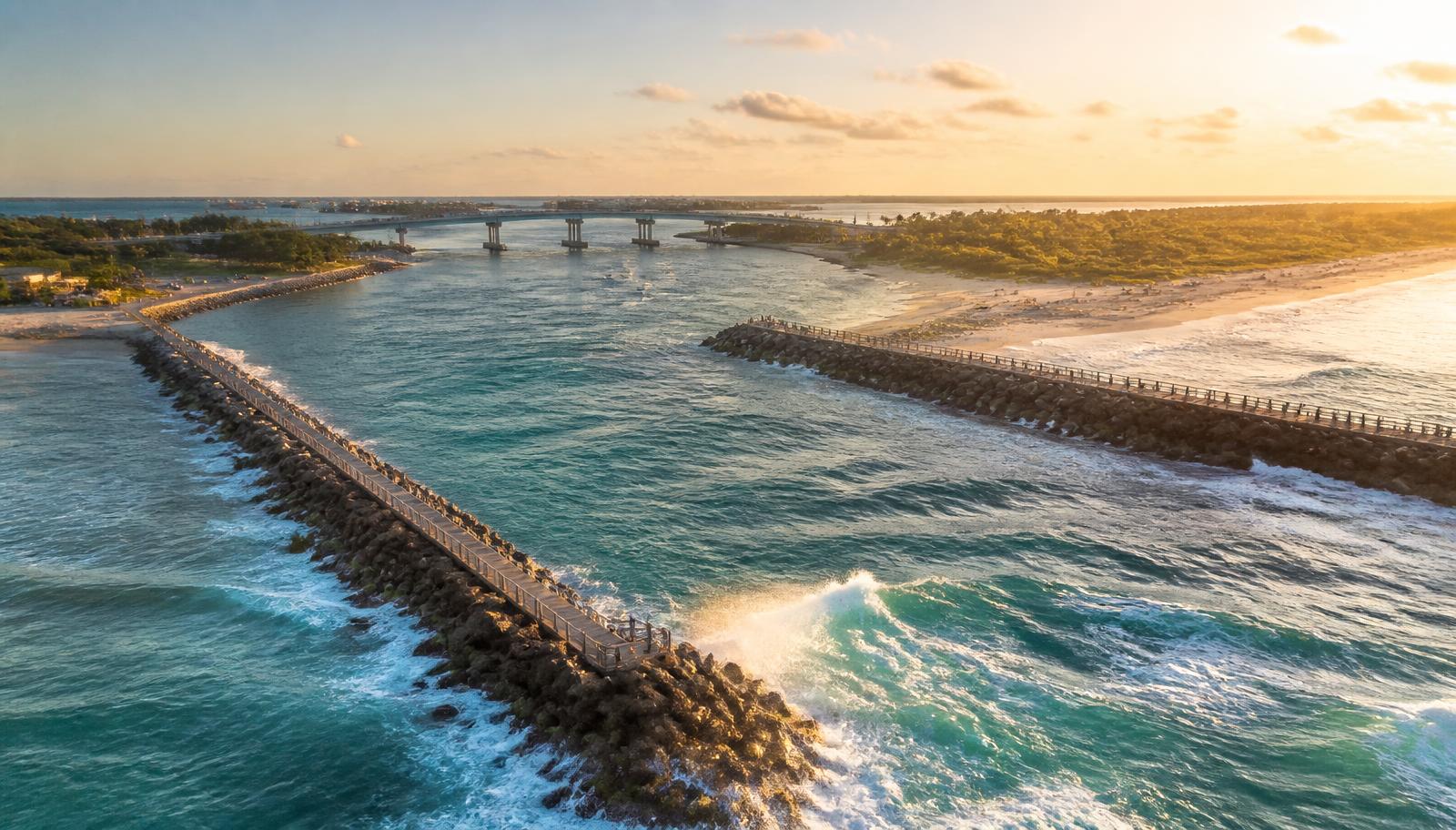
Sebastian Inlet State Park is the reason people move to this stretch of coast. It's the man-made cut where the Indian River Lagoon meets the Atlantic — and that single gap in the barrier island creates everything: the surf break, the bait flow, the snook run, the sandbar, the manatees, the whole fishery.
The park covers roughly 970 acres across three miles of shoreline in both Brevard and Indian River counties, and it consistently ranks among the most-visited fishing destinations in Florida. It's a 20-minute drive from our dock in Grant-Valkaria — or about 25 minutes by boat down the lagoon (6.5 miles to the inlet mouth, 5.4 to the sandbar).
Address: 9700 South Highway A1A, Melbourne Beach, FL 32951 · Phone: 321-984-4852
Hours, fees, and the entrance you want
| Detail | |
|---|---|
| Hours | Open 24 hours a day, 365 days a year |
| Entrance fee | $8 per vehicle (2–8 people); $4 single-occupant vehicle; $2 pedestrian/cyclist |
| North Ranger Station | Staffed/accessible 24 hours — this is the one anglers and surfers use |
| South Ranger Station | Standard park hours 8 a.m.–sunset (changed Nov. 12, 2025). After-hours access only for registered campers or annual-pass holders with an after-hours permit |
| Annual pass | Florida State Parks annual family pass pays for itself in about 15 visits |
Two practical notes for 2026:
- · On weekends and peak periods, the north side can hit capacity and temporarily close to incoming vehicles. If you're not through the gate by ~9 a.m. on a Saturday in season, plan for the south side or an afternoon arrival.
- · Beginning May 2026, construction starts on the Sebastian Inlet bridge along Jimmy Buffett Memorial Highway (A1A). Expect congestion, noise, possible changes to campground access, and even camping-reservation cancellations. Allow extra travel time and check the park's alerts before a long drive.
Check conditions before you leave
Don't guess. The Sebastian Inlet District runs a live webcam on the north jetty with six views — surf, jetty, north beach, the lagoon side. We've embedded all of them on our live inlet cam page so you can read the surf, wind and current from the porch with your coffee.
The rule of thumb: glassy lines outside the north jetty = go surf. Standing waves and a hard rip at the mouth = an outgoing tide fighting an east swell; keep small boats inside until slack tide.
The north side: jetty, catwalk, and First Peak
The north side is the action side.
The north jetty catwalk is a railed fishing platform that runs out along the rocks — this is where you'll see anglers three deep at dawn during the fall mullet run. It's ADA-accessible for a good stretch, lit at night, and it's open around the clock, which is why the North Ranger Station never closes.
First Peak is the wave that made this place famous. The sandbar just north of the jetty focuses swell into a punchy right-hander that has hosted pro contests for decades. Just outside, Monster Hole breaks on an offshore bar — boat or long paddle only, and strictly for experienced surfers.
Also on the north side: the surf shop and concession (Inlet Grill), restrooms and showers, the main swim beach, and the boat ramp on the lagoon side.
The south side: tidal cove, museums, and the quiet beach
The south side is the family side.
The tidal cove is the single best feature of this park for anyone with small kids. It's a shallow, protected pocket of lagoon water on the inside of the inlet — warm, calm, sandy, with a straight view down the channel at the boat traffic. Bring a shade tent; there's very little natural cover.
The south jetty offers the same fishery with a fraction of the crowd, plus a much shorter walk from the parking lot.
Two museums, both worth an hour:
- · McLarty Treasure Museum — built on the survivors' camp of the 1715 Spanish Plate Fleet, which wrecked along this exact shoreline in a hurricane. Gold and silver recovered from the wrecks, a good short film, and the reason this is called the Treasure Coast.
- · Sebastian Fishing Museum — the history of the commercial fishing families who built these towns; nets, boats, and the story of the 1995 net ban that rewrote the local economy.
Fishing: what's biting and when
The inlet is a funnel, and everything eats in a funnel.
| Season | Target species | Where |
|---|---|---|
| Spring (Mar–May) | Snook, redfish, black drum, sheepshead | Jetty rocks, catwalk, lagoon flats |
| Summer (Jun–Aug) | Tarpon, snook, mangrove snapper, jacks | Inlet mouth on the tide, night under the lights |
| Fall (Sep–Nov) | Mullet-run blitz: snook, tarpon, big jacks, bluefish, Spanish mackerel | Beach and jetty — the best six weeks of the year |
| Winter (Dec–Feb) | Sheepshead, black drum, pompano, flounder, trout | Catwalk pilings, south jetty, lagoon |
Licensing: a Florida saltwater fishing license is required for most anglers 16–64. Fishing from a licensed pier or from shore has its own rules — Florida residents fishing from shore need the (free) shoreline license, non-residents need a full saltwater license. Snook and lobster require separate stamps. Buy online through the FWC before you arrive; rangers do check.
Regulations that catch visitors out: snook and redfish are tightly managed with slot limits and seasonal closures that change by region and by year. Check current FWC rules the week of your trip — not last year's blog post, including this one.
Want the deep version? We wrote a full fishing Sebastian Inlet guide covering species, tackle, tides, and the best shore spots.
Boating, paddling, and the ramp
There's a boat ramp on the lagoon side of the park, and it's the closest launch to the ocean on this stretch. Trailer parking fills early on good-weather weekends.
If you're staying with us, you don't need it: we have two boat ramps within two miles, a private deep-water dock, and kayaks and paddleboards included. Launch here, run the lagoon south, and you're at the inlet — and the famous Sebastian Inlet sandbar — without ever hitching a trailer.
Paddling note: the inlet channel itself is not a kayak playground. Current runs hard, boat traffic is constant, and the ocean is right there. Paddle the lagoon side, the mangrove shoreline, and the spoil islands instead.
Camping
The park has a campground for RVs and tents on the lagoon side, plus a primitive/boat-in option. It books out months ahead for winter, and reservations may be disrupted by the 2026 bridge construction. If your group is bigger than a campsite or the campground is full, a house with a dock, laundry, and a real kitchen 20 minutes away tends to win the vote.
Wildlife, turtles, and the rules that protect them
- · Sea turtle nesting season runs roughly March through October. Loggerheads, greens, and leatherbacks nest on these beaches in some of the highest densities in the Western Hemisphere. Fill in holes, knock down sandcastles, no white flashlights on the beach at night, and never disturb a marked nest.
- · Manatees move through the lagoon side year-round and cluster in cooler months. Idle speed, no chasing, no feeding.
- · Birding is excellent: pelicans, roseate spoonbills, ospreys, frigatebirds after storms.
- · Shelling is best after a hard east blow, on a falling tide, on the north beach.
Accessibility
The park does well here: accessible parking, restrooms, a mobi-mat beach access, and a long ADA-accessible stretch of the north jetty catwalk. Beach wheelchairs are available — call ahead at 321-984-4852.
A perfect day at the inlet (our version)
- · 6:45 a.m. — Coffee on our dock, check the live cam.
- · 7:30 a.m. — Through the North Ranger Station before the crowd. Fish the catwalk on the incoming tide.
- · 10:30 a.m. — Swap sides. Tidal cove on the south for the kids, shade tent up.
- · 12:00 p.m. — McLarty Treasure Museum while the sun is at its worst.
- · 1:30 p.m. — Lunch at the Inlet Grill, or drive 12 minutes to Squid Lips in Sebastian for a table on the water.
- · 3:00 p.m. — Shelling on the north beach as the tide falls.
- · 6:00 p.m. — Back to the house, fish cleaned on the dock, sunset over the river.
What to bring
Reef-safe sunscreen, a shade tent (there is almost none on the beach), more water than you think, cash for the entrance if the card reader is down, a small cooler, polarized sunglasses (essential for spotting fish and for the glare off the jetty), and hard-soled shoes if you plan to walk the rocks.
FAQ
Stay 20 minutes away
We're on the Indian River in Grant-Valkaria — private dock, kayaks included, dog friendly, sleeps 8. Check the live cam, load the cooler, and be at the jetty before the sun is over the rocks.
Related reading: camping at Sebastian Inlet State Park · best fishing spots at the inlet · nearby beaches
Boat and kayak launches near the house
Tap a launch to move the map. Drive times are from Sunrise on the River in Grant-Valkaria.
US-1 at Grant, Grant-Valkaria — Closest launch to the house. One concrete lane, boarding dock, straight into the lagoon with no bridges to Sebastian Inlet.
- Drive to Grant Boat Ramp at that hour: 4 min each way (15 min to unload and rig).
- On the water about 7:19 am, back home around 9:23 am.
- Total trip: 2.4 hours.
- Best departure for flat water and light traffic: 6:00 am — the lagoon is usually glass until about 10am.
| Launch | Drive | Fee | Route |
|---|---|---|---|
| 3 min · 1.2 mi | Free | Directions | |
| 5 min · 2.0 mi | Free | Directions | |
| 6 min · 2.0 mi | Free | Directions | |
| 18 min · 11 mi | Free | Directions | |
| 22 min · 14 mi | Free | Directions | |
| 22 min · 14 mi | $4–$5 per vehicle | Directions | |
| 20 min · 12 mi | $8 per vehicle | Directions | |
| 25 min · 17 mi | Free | Directions |
Three ways to stay and paddle
Kayaks are included with every stay at Sunrise on the River, launched from our own dock on the Indian River Lagoon — no rental counter, no trailer, no drive.
Sunrise Paddle Weekend
- · Kayaks included — launch straight off the private dock
- · Paddleboard-flat water from first light to about 10am
- · Fire pit and gazebo for the evening
Lagoon & Spoil Islands Week
- · Kayaks all week, no rental fees
- · Paddle the spoil islands and the Sebastian sandbar
- · Boat ramps under 2 miles for your own trailer
Snowbird Paddle Month
- · Kayaks, dock and screened porch for the whole stay
- · Manatee season on Turkey Creek and the St. Sebastian River
- · Two dogs welcome — $100 per dog per stay
Cleaning $150, dogs $100 each per stay, no resort fees. Check live availability.
Frequently asked
How much does Sebastian Inlet State Park cost?
$8 per vehicle for 2–8 people, $4 for a single-occupant vehicle, and $2 per pedestrian or cyclist. A Florida State Parks annual pass covers unlimited entries and pays off after roughly 15 visits.
What are Sebastian Inlet State Park hours?
The park is open 24 hours a day, 365 days a year. The North Ranger Station operates around the clock; as of November 12, 2025 the South Ranger Station runs standard hours of 8 a.m. to sunset, with after-hours access limited to registered campers and annual pass holders holding an after-hours permit.
How far is Sebastian Inlet State Park from Grant-Valkaria?
About 20 minutes by car from our house in Grant-Valkaria, or roughly 25 minutes by boat down the Indian River Lagoon from our private dock — 6.5 miles to the inlet mouth.
Do I need a fishing license at Sebastian Inlet?
Yes for most anglers aged 16–64. Florida residents fishing from shore need the free shoreline saltwater license; non-residents need a full saltwater license. Snook and lobster require separate stamps. Buy through the FWC online before you arrive.
Is there a live webcam for Sebastian Inlet?
Yes — the Sebastian Inlet District operates webcams on the north jetty that update every few minutes. We show all six views on our live inlet cam page so you can check surf, wind and current before heading out.
Can you swim at Sebastian Inlet?
Yes, at the designated beaches. Never swim in the inlet channel itself — the current is dangerous and boat traffic is constant. The protected tidal cove on the south side is the safest option for young children.
Is Sebastian Inlet State Park dog friendly?
Leashed pets are allowed in most areas of the park including the campground and many trails, but not on the designated swimming beaches or inside buildings. Our house is dog friendly, so your dog is welcome for the rest of the trip too.
What is the best time of year to visit Sebastian Inlet?
October and November for the mullet run and the best fishing of the year; March through May for warm water, light crowds and good surf; summer for tarpon and long beach days, though afternoon thunderstorms are routine.
Will the 2026 bridge construction affect my visit?
Construction on the Sebastian Inlet bridge along A1A is scheduled to begin in May 2026, bringing traffic congestion, noise, possible campground entrance changes and even camping reservation cancellations. Allow extra travel time and check the park's alerts before your trip.
The river, once a month
Fishing report, rocket launch dates, sandbar and manatee season, local events — plus the open dates we'd love to fill. One email a month, no spam.
One email a month. Unsubscribe any time — we never share your address.