
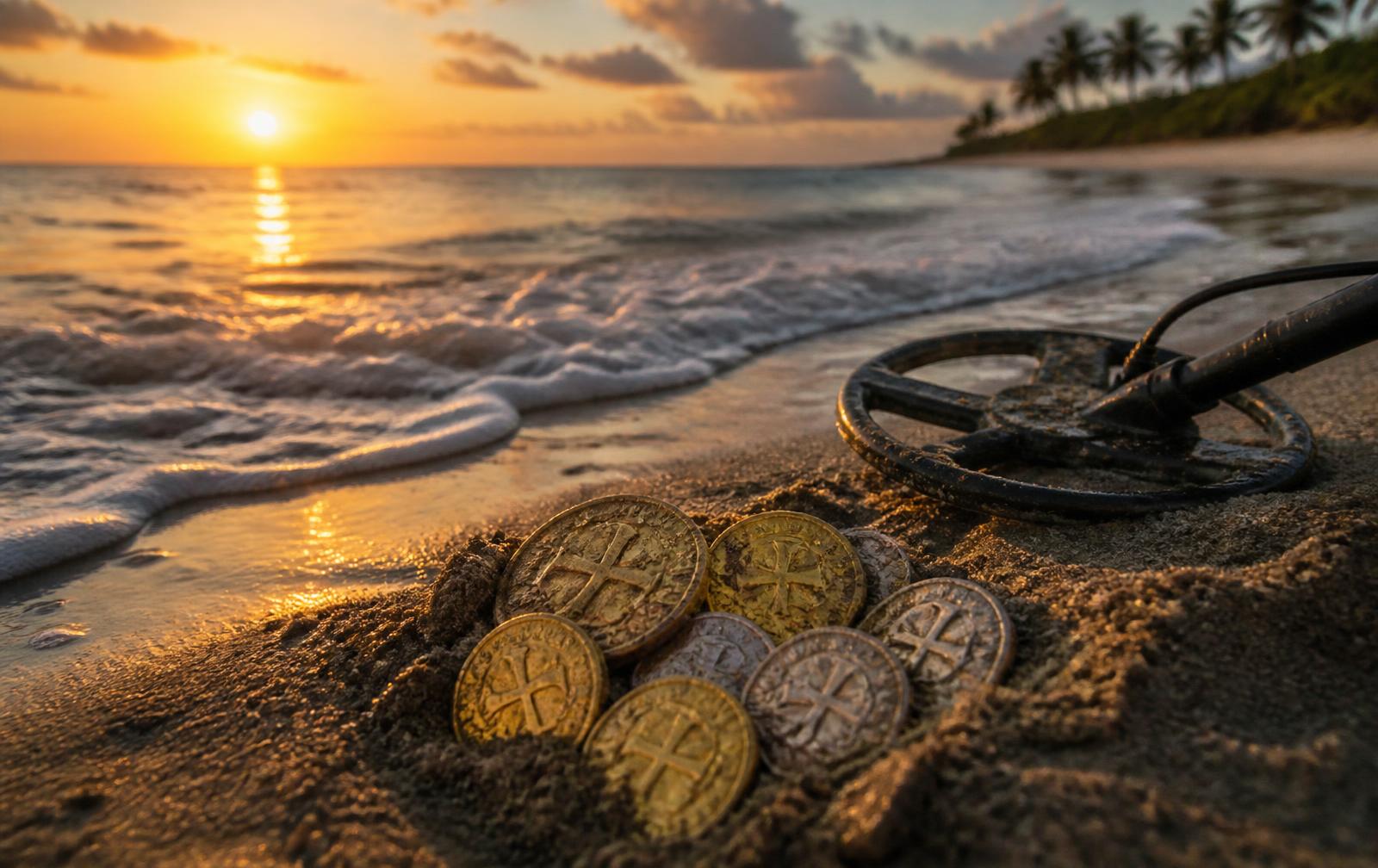
Ten minutes of driving from the dock puts you on the beaches where 1715-fleet coins still wash in after a storm.
Quick answers
- Why is it called the Treasure Coast?
- Because of a real shipwreck. On July 31, 1715 a hurricane destroyed a Spanish treasure fleet — eleven of the twelve ships that had left Havana bound for Spain — along the coast between Melbourne Beach and Fort Pierce. Coins and artifacts from that fleet still wash ashore, and the name stuck to Indian River, St. Lucie and Martin counties.
- Can you still find Spanish coins on the beach near Sebastian?
- Yes, and people do — usually after a nor'easter or a hurricane swell strips sand off the beach. Finds are rare and unpredictable, but silver 'pieces of eight', musket balls, spikes and pottery shards turn up most often on the Indian River County beaches south of Sebastian Inlet, in the Wabasso, Turtle Trail, Corrigan's and Rio Mar stretch.
- Where can I see real 1715-fleet treasure?
- Two museums, both a short drive from the house: Mel Fisher's Treasure Museum at 1322 US-1 in Sebastian (Mon–Sat 10a–5p, Sun 12–5p) and the state-run McLarty Treasure Museum at 13180 N A1A inside Sebastian Inlet State Park, built on the actual 1715 survivors' salvage camp (typically 10a–4p, Wed–Sun — call ahead, it is volunteer-staffed).
- Is metal detecting legal on Treasure Coast beaches?
- Recreational detecting is generally allowed on the ocean beach at Sebastian Inlet State Park (standard $8 per-vehicle entry) and on most public county beaches, but rules differ park by park, so ask at the ranger station. Under Florida Statutes Chapter 267 any artifact more than 50 years old belongs to the state and has to be reported — you do not automatically keep a Spanish coin.
- Can I dive the 1715 shipwrecks myself?
- Not on the wreck sites. The productive 1715 sites sit under state leases held by salvage operators, and legal digging there is only done by their permitted subcontractors. What visitors can do is beachcomb, detect where it is allowed, dive the public reefs and ledges off the inlet with a charter, or join a treasure-hunting course or workshop run by a local operator.
Most guests find out where they are staying by accident. They drive south on A1A, see a brown sign for a "Treasure Museum," and ask us at check-in whether the gold thing is real.
It is. The coastline that starts about fifteen minutes from Sunrise on the River is called Florida's Treasure Coast for a literal reason: an entire Spanish treasure fleet was destroyed here in a single night in 1715, and three centuries later the ocean is still handing pieces of it back.
Here is the actual history, where the coins turn up, what the law lets you keep, both museums worth your time, and how to turn all of it into a day out of our dock.
The night that named this coast
In the summer of 1715, two Spanish fleets — the Tierra Firme and New Spain convoys — joined up in Havana with three years of accumulated New World wealth: gold bars and discs, chests of silver "pieces of eight," Colombian emeralds, Chinese porcelain, jewelry made for the Spanish court. Spain was broke after the War of the Spanish Succession and needed the shipment badly.
Twelve ships sailed on July 24, 1715, timed — badly — against hurricane season. On the night of July 30–31, a hurricane caught the convoy off the Florida coast between what is now Melbourne Beach and Fort Pierce and drove the ships onto the shallow reefs and bars. Eleven of the twelve were lost. Only the French ship *Griffon*, which had pushed ahead of the fleet, survived.
Around a thousand people died. The survivors came ashore, built a salvage camp near present-day Sebastian Inlet, and spent months recovering what they could while messengers went to Havana and St. Augustine for help. They got a lot of it back — and left a lot behind.
What is left is what makes the name stick: reporting on the fleet consistently puts the value of the treasure still unaccounted for at roughly $400 million. It is not in a vault. It is in the sand, in fifteen feet of water, three hundred to a thousand feet off the beach.
"Today's the day" — Mel Fisher and the modern hunters
The man who turned this into a profession moved to Vero Beach in the 1960s to work the 1715 wrecks with a partnership called the Real Eight Company, using a homemade device — the "mailbox" — that blew clean surface water down onto the bottom to move sand. It worked. They recovered coins by the thousands.
Mel Fisher later went south and spent sixteen years chasing the *Nuestra Señora de Atocha* off Key West, repeating the line his crews still quote here: "Today's the day." In 1985, it was. But the Treasure Coast is where he learned the trade, and his family's operation has worked the 1715 sites off this coast ever since.
They are not alone, and this is not history-channel nostalgia. The state-leased 1715 sites are still worked every season by salvage crews and their permitted subcontractors, and finds still make the news: gold chains, royal-presentation coins, silver reales in clumps, artifacts in water shallow enough to free-dive. That is the strange thing about this stretch of coast — the treasure is not in an abyss. It is in the surf zone.
Where the coins actually come ashore
Beach finds are driven by weather, not luck. A nor'easter or a hurricane swell scours sand off the beach face and exposes the old shell-and-coquina layer where heavy objects have settled. The days *after* a big blow — not during it — are when detectorists show up before sunrise.
The productive stretch is south of the inlet, in Indian River County:
| Beach access | Drive from the house | Why it matters |
|---|---|---|
| Sebastian Inlet State Park (south side) | 11 mi · 20 min | Closest wreck-coast beach; detecting generally allowed on the ocean beach, $8/vehicle |
| Ambersand & Bonsteel / Seagrape | 13–16 mi · 25 min | Quiet accesses, low crowds, good post-storm scarping |
| Wabasso Beach Park | 15 mi · 25 min | Free lifeguarded access, restrooms — the easy family base |
| Turtle Trail access | 17 mi · 28 min | Long-time detectorist parking spot |
| Corrigan's / Rio Mar area | 18–22 mi · 30–35 min | Named for a 1715 wreck site offshore; the most storied beach on this list |
| Treasure Shores Park | 16 mi · 27 min | Big parking lot, dunes, boardwalk — good for a long walk north |
Realistic expectation, honestly stated: most people who walk these beaches find sea glass, shark teeth, fossilized bone and modern jewelry. Spanish silver is a rare event. But it happens here in a way it happens almost nowhere else, and looking is free.
Beach details, parking and turtle-nesting rules are in our beaches guide.
The two museums — and they are different
Mel Fisher's Treasure Museum · Sebastian
1322 US Highway 1, Sebastian · (772) 589-9875 · Mon–Sat 10a–5p, Sun 12–5p — about 9 miles / 16 minutes south of the house on the same road you'll drive for groceries.
The Fisher family's own museum: an introductory film, interactive displays, cannons, encrusted artifacts, silver and gold recovered from the 1715 fleet and other wrecks, plus a shop where authentic coins and artifacts are actually sold. It is the crowd-pleaser of the two — the place kids remember.
McLarty Treasure Museum · inside Sebastian Inlet State Park
13180 N A1A, Sebastian Inlet State Park · (772) 589-2147 · typically 10a–4p, Wed–Sun — about 11 miles / 20 minutes, and it is worth the extra ten minutes for one reason: the museum is built on the site of the 1715 survivors' salvage camp. You are standing where they camped.
It is a state museum: exhibits, dioramas, a documentary film on the fleet, artifacts and replicas, and a dune-top view of the water the ships went down in. Hours are volunteer-dependent and holidays close it — call before you drive. Small admission at the door, separate from park entry.
Pair it with the park's other free museum on the north side and the jetties: see our Sebastian Inlet State Park guide.
What the law says you can keep
Read this part before you buy a detector.
- · Anything more than 50 years old belongs to the State of Florida. Under Florida Statutes Chapter 267, historic artifacts on state land and state-owned submerged land are state property and are supposed to be reported to the Division of Historical Resources. A 1715 coin is not finders-keepers.
- · Detecting rules are per-park, not statewide. Recreational detecting is generally permitted on the ocean beach at Sebastian Inlet State Park with normal $8-per-vehicle entry, and on many public county beach accesses. Some parks, refuges and all archaeological sites prohibit it outright. Ask at the ranger station — a two-minute question saves a citation.
- · Never dig in the dunes or in vegetation, and never on a marked sea turtle nest (nesting season runs roughly March 1 – October 31 on the Archie Carr beaches right here). Stay on the wet, open beach face.
- · Filling your holes is not just etiquette; it is the difference between detectorists being welcome on these beaches and not.
- · The offshore wreck sites are leased. Diving to dig on a 1715 site without being a permitted subcontractor of the lease-holder is a serious offense. If you want to dig, the legal route is joining a licensed operation's crew program or workshop.
Four ways guests actually do the treasure thing
1. The museum morning (2–3 hours, easy). Mel Fisher's in Sebastian at 10, lunch on the water at Squid Lips or Capt. Hiram's, home by early afternoon. Perfect rain-day plan.
2. The full wreck-coast day (6–8 hours). Drive south to McLarty inside the state park, then the beach below it, then work your way down the A1A accesses — Turtle Trail, Corrigan's, Rio Mar — with a cooler and a detector. Finish with the inlet jetty at sunset.
3. The post-storm sunrise walk (free). Watch the forecast. After the first big east or northeast blow of the season, be on the beach at first light with polarized glasses. Look for black shell layers, coquina hash, and cuts in the sand face — heavy metal collects where the beach is scarped, not where it is soft and pretty.
4. The water version. Charter out of Sebastian Inlet and dive or snorkel the shallow nearshore ledges and reefs — legally, on public bottom, not on the wreck leases. Local dive shops also run treasure-hunting courses and organized hunts. Operators are listed in boat rentals and charters, and inlet conditions are on our live cam and conditions page.
What to bring
- · Polarized sunglasses. Half of beachcombing is glare management.
- · A sand scoop with a long handle if you're detecting — a plastic beach shovel will ruin your morning.
- · A mesh bag for finds and trash. Pull the fishing line and bottle caps out; you'll be the reason the county keeps allowing this.
- · Tide table. Work the two hours either side of low tide — that is when the productive lower beach is exposed. Tides are on our inlet conditions page.
- · Sun protection and water. There is no shade on any of these accesses.
Your basecamp on the lagoon
Sunrise on the River sits in Grant-Valkaria on the Indian River Lagoon — 3BR/2BA, single-story, private dock, kayaks included, screened porch, fire pit, sleeps 8, two dogs welcome. Mel Fisher's museum is 16 minutes down US-1, McLarty and the inlet 20, and the wreck beaches 25–35. Sebastian Inlet is 5.4 miles by boat from our dock.
Come back salty, rinse off, put whatever you found on the picnic table, and watch the sun go down over the same water the 1715 fleet was trying to ride north on the Gulf Stream.
[Check dates and book direct →](/availability)
Related reading: Sebastian Inlet State Park guide · beaches and accesses · fishing the inlet · boat rentals & charters · things to do · build your day-by-day itinerary
Boat and kayak launches near the house
Tap a launch to move the map. Drive times are from Sunrise on the River in Grant-Valkaria.
US-1 at Grant, Grant-Valkaria — Closest launch to the house. One concrete lane, boarding dock, straight into the lagoon with no bridges to Sebastian Inlet.
- Drive to Grant Boat Ramp at that hour: 4 min each way (15 min to unload and rig).
- On the water about 7:19 am, back home around 9:23 am.
- Total trip: 2.4 hours.
- Best departure for flat water and light traffic: 6:00 am — the lagoon is usually glass until about 10am.
| Launch | Drive | Fee | Route |
|---|---|---|---|
| 3 min · 1.2 mi | Free | Directions | |
| 5 min · 2.0 mi | Free | Directions | |
| 6 min · 2.0 mi | Free | Directions | |
| 18 min · 11 mi | Free | Directions | |
| 22 min · 14 mi | Free | Directions | |
| 22 min · 14 mi | $4–$5 per vehicle | Directions | |
| 20 min · 12 mi | $8 per vehicle | Directions | |
| 25 min · 17 mi | Free | Directions |
Three ways to stay and paddle
Kayaks are included with every stay at Sunrise on the River, launched from our own dock on the Indian River Lagoon — no rental counter, no trailer, no drive.
Sunrise Paddle Weekend
- · Kayaks included — launch straight off the private dock
- · Paddleboard-flat water from first light to about 10am
- · Fire pit and gazebo for the evening
Lagoon & Spoil Islands Week
- · Kayaks all week, no rental fees
- · Paddle the spoil islands and the Sebastian sandbar
- · Boat ramps under 2 miles for your own trailer
Snowbird Paddle Month
- · Kayaks, dock and screened porch for the whole stay
- · Manatee season on Turkey Creek and the St. Sebastian River
- · Two dogs welcome — $100 per dog per stay
Cleaning $150, dogs $100 each per stay, no resort fees. Check live availability.
Frequently asked
What happened to the 1715 Spanish treasure fleet?
Twelve ships left Havana on July 24, 1715 loaded with gold, silver, emeralds and porcelain bound for Spain. On the night of July 30–31 a hurricane drove the fleet onto the shallows between present-day Melbourne Beach and Fort Pierce. Eleven ships were lost and roughly a thousand people died; only the French ship Griffon survived because it had run ahead of the convoy.
How much 1715 treasure is still missing?
Estimates commonly cited for the treasure still unrecovered off Florida's Treasure Coast run to about $400 million in gold and silver. Much of it lies in shallow water within a few hundred to a thousand feet of the beach, in depths as little as 10 to 20 feet.
Which beach is best for finding 1715 coins near Sebastian?
The Indian River County accesses south of Sebastian Inlet — the Wabasso, Turtle Trail, Corrigan's and Rio Mar stretch — have the longest record of beach finds, along with the ocean beach at Sebastian Inlet State Park. Go in the days after a nor'easter or hurricane swell, around low tide, and look for scarped sand and dark shell layers.
Do I get to keep a Spanish coin I find on a Florida beach?
Not automatically. Under Florida Statutes Chapter 267, artifacts more than 50 years old on state land or state-owned submerged land are state property and must be reported to the Florida Division of Historical Resources. Modern jewelry and coins are a different matter, but historic treasure is not finders-keepers.
Where is the Mel Fisher Treasure Museum and what does it cost?
Mel Fisher's Treasure Museum is at 1322 US Highway 1 in Sebastian, (772) 589-9875, open Monday–Saturday 10am–5pm and Sunday noon–5pm. Admission is collected at the door and there is a shop selling authentic recovered coins and artifacts — call for current pricing before you go.
What is the McLarty Treasure Museum?
A Florida state museum at 13180 N A1A inside Sebastian Inlet State Park, built on the site of the 1715 fleet survivors' salvage camp. It shows artifacts, dioramas and a documentary on the disaster, and is usually open 10am–4pm Wednesday through Sunday. It is staffed by volunteers, so call (772) 589-2147 to confirm before driving.
Can you metal detect at Sebastian Inlet State Park?
Recreational metal detecting is generally allowed on the ocean beach at Sebastian Inlet State Park with the standard $8 per-vehicle entry, but not in dunes, vegetation or archaeological areas, and rules vary by park. Confirm at the ranger station, avoid marked sea turtle nests during nesting season, fill your holes, and report any artifact over 50 years old.
How far is the Treasure Coast wreck area from Grant-Valkaria?
Sebastian Inlet is about 11 miles by road (20 minutes) or 5.4 miles by boat from our dock. Mel Fisher's museum in Sebastian is 16 minutes, McLarty about 20, and the Wabasso through Rio Mar beach accesses are a 25 to 35 minute drive south on A1A.
The river, once a month
Fishing report, rocket launch dates, sandbar and manatee season, local events — plus the open dates we'd love to fill. One email a month, no spam.
One email a month. Unsubscribe any time — we never share your address.