
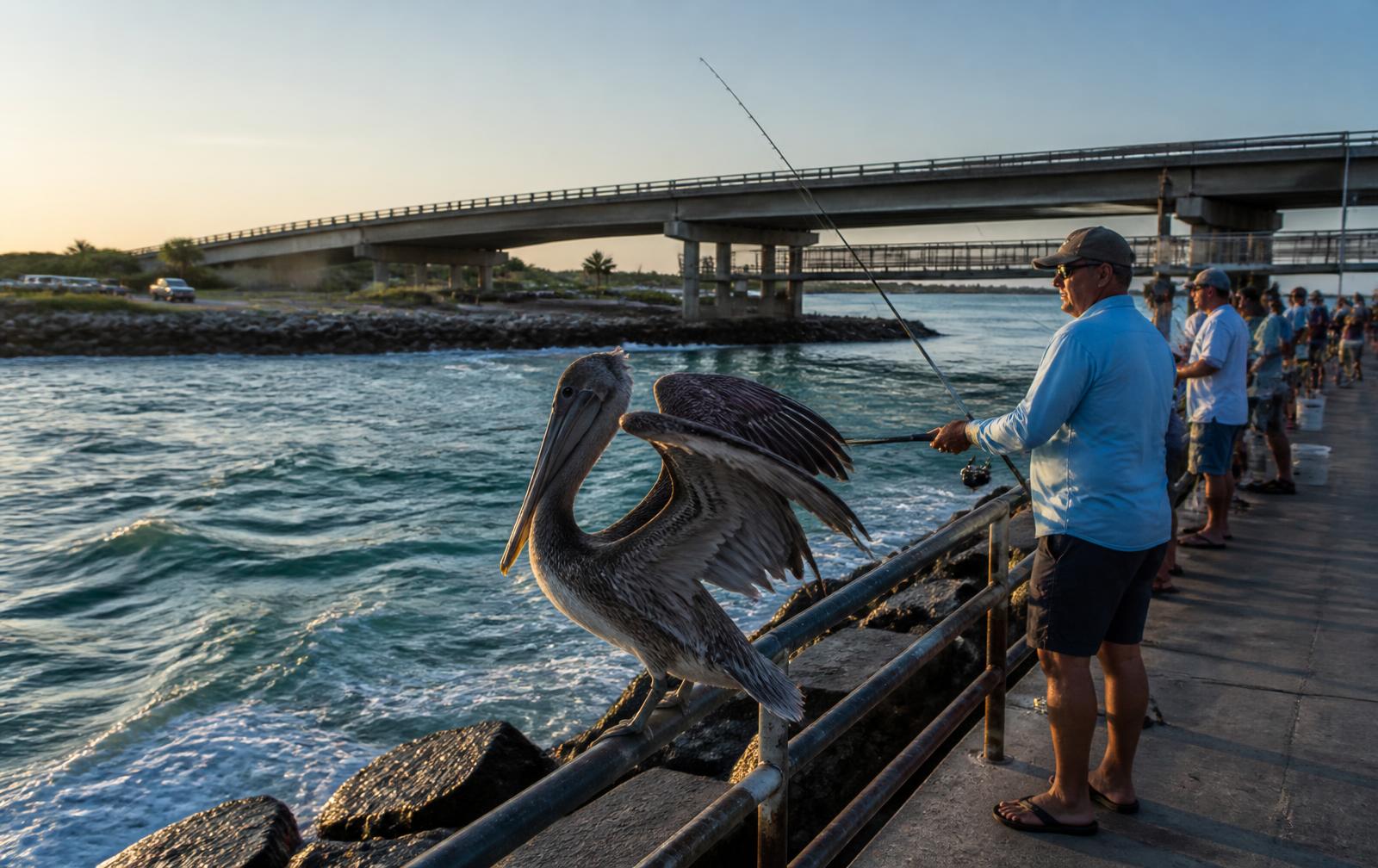
The north jetty at first light — the single most productive land-based fishing spot on Florida's east central coast.
Quick answers
- What is the best fishing spot at Sebastian Inlet?
- The north jetty, fished on the last two hours of the outgoing tide. It reaches the deepest water of the inlet and produces snook, redfish, Spanish mackerel, jacks and tarpon from shore.
- Do I need a fishing license?
- Yes — a Florida saltwater license for anyone 16–64, available instantly at gooutdoorsflorida.com. You do not need one when fishing from the state park's piers or catwalks, which are license-exempt.
- When is the best time to fish the inlet?
- Two hours either side of the tide change, at dawn or dusk. October and November (the mullet run) are the single best weeks of the year.
- Where can I fish with kids?
- The tidal pool and the T-Dock on the lagoon side — calm, shallow, shaded, and full of snapper, sheepshead and pinfish.
- Can I fish Sebastian Inlet without a boat?
- Yes. The jetties, both A1A catwalks, the T-Dock, the tidal pool and the surf are all walk-on spots inside the state park for the $8 vehicle entry fee.
If you only have one morning, fish the north jetty on a falling tide. That's the short answer. The long answer is that Sebastian Inlet is really six or seven distinct fisheries stacked on top of each other, and the spot that produces on a January cold front is the wrong spot in July.
We live 20 minutes north in Grant-Valkaria and run the lagoon down to the inlet all season. Below is where we actually go, in order of how reliably they produce.
The best spots, ranked
| # | Spot | Best tide | Main species | Access |
|---|---|---|---|---|
| 1 | North jetty | Last 2 hrs outgoing | Snook, redfish, tarpon, jacks | Walk, state park |
| 2 | North catwalk (under A1A) | Both, night | Snook, sheepshead, black drum | Walk, license-exempt |
| 3 | South jetty | Incoming | Spanish mackerel, bluefish, pompano | Walk, state park |
| 4 | Tidal pool (south side) | Incoming | Snapper, sheepshead, pinfish | Walk, kid-friendly |
| 5 | T-Dock / lagoon pier | Slack to incoming | Trout, snook, drum | Walk, license-exempt |
| 6 | Surf, north of jetty | Any, dawn | Pompano, whiting, mackerel | Walk, beach |
| 7 | Inlet channel (boat) | Outgoing | Tarpon, snook, big jacks | Boat only |
| 8 | Long Point flats | Rising | Trout, redfish | Boat / kayak |
| 9 | Spoil islands | Rising | Trout, snook, ladyfish | Boat / kayak |
| 10 | Coconut Point flats | Early incoming | Redfish, trout | Kayak launch |
| 11 | Mangrove shorelines, Micco | High | Snook, juvenile tarpon | Kayak |
| 12 | Our dock, Grant-Valkaria | Any | Trout, sheepshead, snapper | Guests only |
1. The north jetty
The concrete north jetty reaches into the deepest, fastest water in the inlet, which is why it is crowded at dawn and worth it anyway.
- · Tide: the last two hours of the outgoing tide, when bait gets flushed out of the lagoon.
- · Where to stand: the last third of the jetty for tarpon and big snook; the inside corner near the beach for redfish and jacks.
- · Tackle: 7'–8' medium-heavy spinning, 20–30 lb braid, 40 lb fluorocarbon leader. Live mullet or croaker, or a 1/2 oz jig with a white paddletail.
- · Etiquette: cast straight out, not across your neighbor. Everyone here has been hooked by somebody's mishandled cast; nobody enjoys it.
- · Safety: the concrete is slick when wet, there is no railing on the outer end, and the rocks below are unforgiving. Wet-weather cleats or spiked sandals are the local uniform.
2. The catwalks under the A1A bridge
The two catwalks under the bridge are the best night fishery at the inlet, and they're license-exempt — the state park's piers, catwalks and docks don't require a Florida saltwater license.
- · Snook stack up in the shadow line the bridge lights cast on the water. Cast into the dark side and swim your bait into the light.
- · Winter is sheepshead and black drum season here: fiddler crab or shrimp on a knocker rig, right against the pilings.
- · Bring a hoop net or a long-handled net. Landing a 30-inch snook straight up over a rail loses fish and breaks rods.
3. The south jetty and the tidal pool
The south side of the inlet is in Indian River County and is generally quieter than the north.
- · The south jetty shines on an incoming tide for Spanish mackerel and bluefish — small silver spoons or a Gotcha plug, retrieved fast.
- · The tidal pool just inside the south side is the best kid spot in the park: hard bottom, gentle slope, calm water, and enough small snapper and pinfish to keep a six-year-old completely occupied. Bring a bucket, not a plan.
4. The lagoon side: T-Dock, flats and islands
Cross under A1A to the lagoon and the fishery changes entirely — shallow, grassy, sight-fishing water instead of moving saltwater.
- · T-Dock / lagoon pier: trout and snook on slack-to-incoming water. Free fishing access, cleaning station and a boat ramp nearby.
- · Long Point flats: 2–4 feet of water over patchy seagrass. Work a soft plastic on a 1/8 oz jighead along the edges on a rising tide.
- · The spoil islands: the man-made islands running up the lagoon hold bait against their drop-offs. Their story is genuinely interesting — see spoil islands and VIP Island.
- · Coconut Point: a non-motorized launch, so the water hasn't been run over by outboards. Best redfish odds of any kayak spot nearby.
When to go: month by month
| Month | What's biting | Best spot |
|---|---|---|
| Jan–Feb | Sheepshead, black drum, pompano | Catwalks, surf |
| Mar–Apr | Snook reopening season, trout, pompano | Jetty, flats |
| May–Jun | Tarpon, snook, mangrove snapper | Jetty tip, channel |
| Jul–Aug | Tarpon at night, snapper, jacks | Catwalks, bridge |
| Sep | Quietest month; trout on the flats | Long Point |
| Oct–Nov | Mullet run — everything, all at once | North jetty |
| Dec | Bluefish, sheepshead, big trout | South jetty, T-Dock |
Licenses, limits and rules
- · License: required for saltwater fishing from shore, boat or wading if you're 16–64. Buy it in two minutes at gooutdoorsflorida.com. The park's piers/catwalks are exempt.
- · Snook: requires a separate snook permit, has a 28–32 inch slot limit, one fish per person per day, and closed seasons (Dec 15–Jan 31 and June 1–Aug 31 on the Atlantic coast). Check the FWC before you keep anything.
- · Redfish: one fish per person per day in the slot; the Indian River Lagoon has been under special catch-and-release restrictions in recent years. Verify current rules.
- · No fishing from the bridge itself, only from the catwalks. Don't leave line, hooks or bait bags — pelicans and turtles pay for that.
Full regulations, tackle detail and charter contacts are in our complete Sebastian Inlet fishing guide and the area fishing directory.
Fishing this from our dock
Guests at Sunrise on the River start from a private dock in Grant-Valkaria: trout, sheepshead and snapper right off the pilings, kayaks included, and 5.4 miles down the lagoon to the Sebastian Inlet sandbar (about 20 minutes) or 6.5 miles to the inlet mouth (about 25). Two public boat ramps are within two miles if you're trailering.
Plan the rest of the trip: on the water · things to do · nearby beaches · Grant-Valkaria area guide · camping at Sebastian Inlet · Grant Seafood Festival · live inlet cam
Boat and kayak launches near the house
Tap a launch to move the map. Drive times are from Sunrise on the River in Grant-Valkaria.
US-1 at Grant, Grant-Valkaria — Closest launch to the house. One concrete lane, boarding dock, straight into the lagoon with no bridges to Sebastian Inlet.
- Drive to Grant Boat Ramp at that hour: 4 min each way (15 min to unload and rig).
- On the water about 7:19 am, back home around 9:23 am.
- Total trip: 2.4 hours.
- Best departure for flat water and light traffic: 6:00 am — the lagoon is usually glass until about 10am.
| Launch | Drive | Fee | Route |
|---|---|---|---|
| 3 min · 1.2 mi | Free | Directions | |
| 5 min · 2.0 mi | Free | Directions | |
| 6 min · 2.0 mi | Free | Directions | |
| 18 min · 11 mi | Free | Directions | |
| 22 min · 14 mi | Free | Directions | |
| 22 min · 14 mi | $4–$5 per vehicle | Directions | |
| 20 min · 12 mi | $8 per vehicle | Directions | |
| 25 min · 17 mi | Free | Directions |
Three ways to stay and paddle
Kayaks are included with every stay at Sunrise on the River, launched from our own dock on the Indian River Lagoon — no rental counter, no trailer, no drive.
Sunrise Paddle Weekend
- · Kayaks included — launch straight off the private dock
- · Paddleboard-flat water from first light to about 10am
- · Fire pit and gazebo for the evening
Lagoon & Spoil Islands Week
- · Kayaks all week, no rental fees
- · Paddle the spoil islands and the Sebastian sandbar
- · Boat ramps under 2 miles for your own trailer
Snowbird Paddle Month
- · Kayaks, dock and screened porch for the whole stay
- · Manatee season on Turkey Creek and the St. Sebastian River
- · Two dogs welcome — $100 per dog per stay
Cleaning $150, dogs $100 each per stay, no resort fees. Check live availability.
Frequently asked
What is the best fishing spot at Sebastian Inlet?
The north jetty, fished during the last two hours of the outgoing tide. It reaches the deepest and fastest water in the inlet and produces snook, redfish, tarpon, jacks and Spanish mackerel from shore.
Can you fish Sebastian Inlet without a boat?
Yes. The north and south jetties, both A1A catwalks, the T-Dock on the lagoon, the tidal pool and the surf are all walk-on spots inside Sebastian Inlet State Park for the $8 per-vehicle entry fee.
Do I need a fishing license at Sebastian Inlet?
A Florida saltwater fishing license is required for anglers 16 to 64 fishing from shore, wading or from a boat. Fishing from the state park's piers, docks and catwalks is license-exempt. Snook also requires a separate snook permit.
What tide is best for fishing Sebastian Inlet?
The last two hours of the outgoing tide for the jetties and channel, because bait flushes out of the lagoon. On the lagoon flats a rising tide is better. Dawn and dusk beat midday in almost every season.
When is the best month to fish Sebastian Inlet?
October and November, during the mullet run, when snook, tarpon, jacks, redfish and mackerel all feed hard on migrating baitfish. Winter is best for sheepshead, black drum and pompano.
Where can kids fish safely at Sebastian Inlet?
The tidal pool on the south side of the park and the T-Dock on the lagoon side. Both are calm, shallow and railed or gently sloped, with plenty of snapper, sheepshead and pinfish to keep kids busy.
What fish can you catch at Sebastian Inlet?
Snook, redfish, spotted seatrout, tarpon, Spanish mackerel, bluefish, pompano, whiting, sheepshead, black drum, mangrove snapper, flounder, jack crevalle and — offshore of the inlet — kingfish and cobia.
Is there fishing on the Indian River Lagoon side?
Yes, and it is quieter. The T-Dock, Long Point flats, the spoil islands and Coconut Point all hold trout, redfish and snook in 2 to 4 feet of water — ideal for kayaks and light tackle.
How far is Sebastian Inlet from Grant-Valkaria by boat?
About 5.4 statute miles to the Sebastian Inlet sandbar, roughly 20 minutes at cruising speed, and 6.5 miles or about 25 minutes to the inlet mouth, running the Intracoastal Waterway south.
Where can I buy bait near Sebastian Inlet?
The state park's own bait and tackle shop sells live shrimp, line and ice. Whitey's Bait & Tackle near Micco is the closest full shop on the mainland, about five minutes from Barefoot Bay.
The river, once a month
Fishing report, rocket launch dates, sandbar and manatee season, local events — plus the open dates we'd love to fill. One email a month, no spam.
One email a month. Unsubscribe any time — we never share your address.