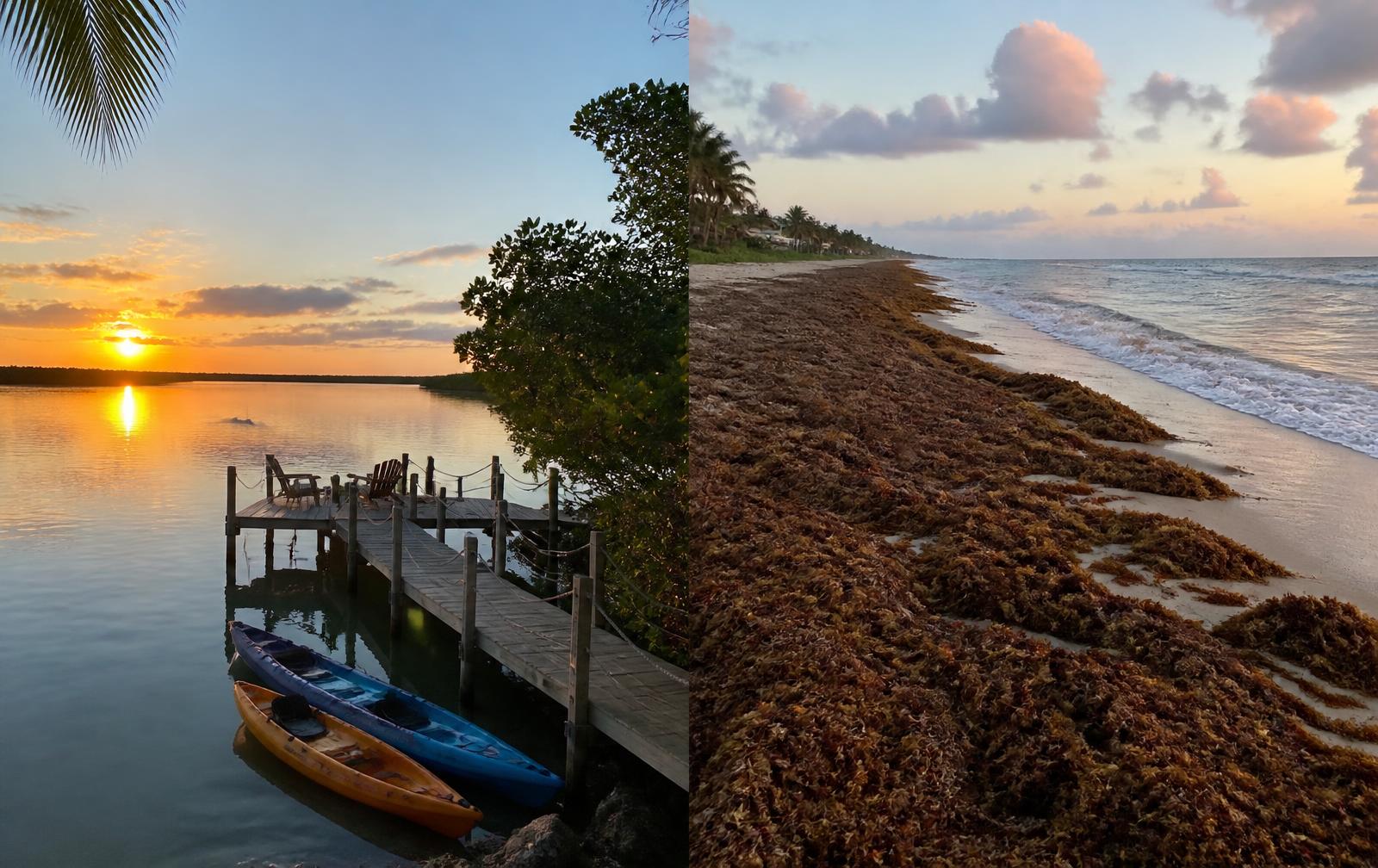
If you've been watching Florida travel news over the past few seasons, you've heard about the Great Atlantic Sargassum Belt — enormous floating mats of brown seaweed that drift toward the Atlantic coast in late spring and summer.
Sargassum matters ecologically: out at sea it's a floating nursery for juvenile sea turtles, mahi, and dozens of fish species. The problem is what happens when it piles up on an oceanfront beach — it decomposes in the sun, releases hydrogen sulfide (that rotten-egg smell), and turns the swim zone into a warm brown soup.
Here's the part most visitors don't know: the Indian River Lagoon doesn't get it. If you're planning a trip to Florida's Space Coast or Sebastian Inlet, this is everything you need to know.
What is sargassum, and why does it reach Florida?
Sargassum is a free-floating macroalgae (it never attaches to the bottom) that thrives in warm ocean water. Since 2011 a recurring belt of it has stretched thousands of miles across the tropical Atlantic, from West Africa to the Gulf. Currents, prevailing easterly winds, and rising water temperature push pieces of that belt toward the Caribbean, the Florida Keys, and up Florida's Atlantic coast.
Three things determine whether it lands on a given beach:
- · Season — arrivals typically build from March through August, usually peaking May–July.
- · Wind direction — a sustained east or southeast wind pushes mats onshore; a west wind holds them offshore.
- · Shoreline shape — open, surf-facing ocean beaches catch it. Sheltered inland estuaries do not.
That third point is the whole story for our stretch of coast.
When sargassum hits Space Coast ocean beaches
| Season | Ocean beaches (Melbourne Beach, Sebastian Inlet, Vero) | Indian River Lagoon (our dock) |
|---|---|---|
| Dec–Feb | Clear; cool water, best beach walking | Clear, calm, manatee season |
| Mar–Apr | Occasional light wrack lines | Clear |
| May–Jul | Peak sargassum risk; some days heavy, many days clean | Clear |
| Aug–Sep | Tapering; mullet run begins | Clear |
| Oct–Nov | Clear; best all-around beach weather | Clear |
Even in peak months it's patchy and wind-driven — one beach can be clean while another two miles south is buried. What you don't want is for your only water access to be that coin flip.
The Indian River Lagoon advantage: no sargassum accumulation
Here's what local boaters and repeat guests know: the Indian River Lagoon is a sheltered inland estuary, not an open-ocean beach. It sits behind the barrier island, is fed by freshwater tributaries, and exchanges water with the Atlantic only through narrow inlets like Sebastian Inlet.
Oceanic sargassum mats simply don't make it through and pile up on lagoon shorelines. When you stay at Sunrise on the River in Grant-Valkaria:
- · Clean, calm water at the dock. Kayak, paddleboard, or wade right off our private dock without pushing through mounds of decaying weed.
- · Odor-free breeze. Morning coffee on the deck and evenings at the fire pit smell like salt marsh and jasmine, not sulfur.
- · Uninterrupted boating and fishing. Channels, the two boat ramps within two miles, and the lagoon flats stay clear and navigable year-round.
- · Wildlife instead of wrack. Dolphins, manatees in the cooler months, roseate spoonbills and ospreys — see the manatees & wildlife guide.
One honest caveat: the lagoon has its own seasonal moods. Summer heat can bring localized algae blooms and, on rare occasions, brief fish-kill events. Those are episodic and local, not the multi-month coastal sargassum pile-ups you read about in the news. If lagoon conditions are ever off during your stay, we'll tell you before you arrive.
The best of both worlds: lagoon base, beach day trips
Staying on the lagoon puts you in control of your vacation instead of at the mercy of the wind forecast.
Relax at home Spend the day on the dock: complimentary kayaks, dolphin-watching, and casting for snook, redfish, and trout in clear lagoon water. Our fishing guide covers licenses, species, and the exact spots.
Visit the beach on your terms Ocean beaches are 15–20 minutes away by car:
| Beach | Drive time | Why go |
|---|---|---|
| Melbourne Beach / Paradise Beach | ~15 min | Wide sand, lifeguards, easy parking |
| Sebastian Inlet State Park | ~20 min | Surf, jetty fishing, tidal cove for kids |
| Wabasso / Vero Beach | ~25 min | Quieter sand, shelling, shops |
Check the live Sebastian Inlet cam before you load the car — you can see surf, wind, and the beach itself from the porch. If it looks weedy, switch to a lagoon day, the sandbar, or one of the things to do inland. No wasted afternoon.
How to check sargassum conditions yourself
- · Live cams — our inlet cam page has six views of the Sebastian Inlet area.
- · USF Optical Oceanography Lab — publishes monthly Sargassum Watch System outlooks for the Caribbean and Florida.
- · Wind forecast — a two-to-three day west or northwest wind usually means clean ocean beaches; sustained east wind in May–July means expect wrack.
- · Just ask us. We live here. Message us the week before your trip and we'll tell you honestly what the water is doing.
Plan your peaceful waterfront escape
Don't let seasonal seaweed decide your Florida getaway. You get pristine water access, a private dock, kayaks, RV and boat parking, and a dog-friendly house right on the Indian River Lagoon — with the ocean a short drive away whenever you want it.
Check availability and book direct to save fees — or read about our long-stay snowbird rates if you're planning a month or more.
Related reading: nearby Atlantic beaches · the Sebastian Inlet sandbar · our dock and kayaks · photo gallery
Boat and kayak launches near the house
Tap a launch to move the map. Drive times are from Sunrise on the River in Grant-Valkaria.
US-1 at Grant, Grant-Valkaria — Closest launch to the house. One concrete lane, boarding dock, straight into the lagoon with no bridges to Sebastian Inlet.
- Drive to Grant Boat Ramp at that hour: 4 min each way (15 min to unload and rig).
- On the water about 7:19 am, back home around 9:23 am.
- Total trip: 2.4 hours.
- Best departure for flat water and light traffic: 6:00 am — the lagoon is usually glass until about 10am.
| Launch | Drive | Fee | Route |
|---|---|---|---|
| 3 min · 1.2 mi | Free | Directions | |
| 5 min · 2.0 mi | Free | Directions | |
| 6 min · 2.0 mi | Free | Directions | |
| 18 min · 11 mi | Free | Directions | |
| 22 min · 14 mi | Free | Directions | |
| 22 min · 14 mi | $4–$5 per vehicle | Directions | |
| 20 min · 12 mi | $8 per vehicle | Directions | |
| 25 min · 17 mi | Free | Directions |
Three ways to stay and paddle
Kayaks are included with every stay at Sunrise on the River, launched from our own dock on the Indian River Lagoon — no rental counter, no trailer, no drive.
Sunrise Paddle Weekend
- · Kayaks included — launch straight off the private dock
- · Paddleboard-flat water from first light to about 10am
- · Fire pit and gazebo for the evening
Lagoon & Spoil Islands Week
- · Kayaks all week, no rental fees
- · Paddle the spoil islands and the Sebastian sandbar
- · Boat ramps under 2 miles for your own trailer
Snowbird Paddle Month
- · Kayaks, dock and screened porch for the whole stay
- · Manatee season on Turkey Creek and the St. Sebastian River
- · Two dogs welcome — $100 per dog per stay
Cleaning $150, dogs $100 each per stay, no resort fees. Check live availability.
Frequently asked
Does sargassum seaweed affect the Indian River Lagoon?
No. The Indian River Lagoon is a sheltered inland estuary behind the barrier island, so oceanic sargassum mats do not accumulate along its shoreline. Heavy sargassum landings are an open-ocean beach phenomenon.
What months is sargassum worst on Florida's Atlantic beaches?
Arrivals generally build from March through August and peak between May and July. Landings are wind-driven and patchy, so individual beaches can be clean or covered on any given day within that window.
Is sargassum dangerous or harmful?
Fresh sargassum is harmless and ecologically valuable. As it decomposes on the beach it releases hydrogen sulfide gas, which produces a strong rotten-egg odor and can irritate eyes and airways for sensitive people. Tiny sea lice or jellyfish larvae can also hide in decaying mats, so avoid wading through thick accumulations.
How far are the ocean beaches from Sunrise on the River?
Melbourne Beach and Paradise Beach are about 15 minutes by car, Sebastian Inlet State Park about 20 minutes, and Vero Beach about 25 minutes. You can check surf and beach conditions on our live inlet cam page before you go.
Can we swim and kayak off the dock?
Yes. Guests kayak, paddleboard, fish, and wade directly from our private dock on the lagoon. Complimentary kayaks are included with the stay.
The river, once a month
Fishing report, rocket launch dates, sandbar and manatee season, local events — plus the open dates we'd love to fill. One email a month, no spam.
One email a month. Unsubscribe any time — we never share your address.