
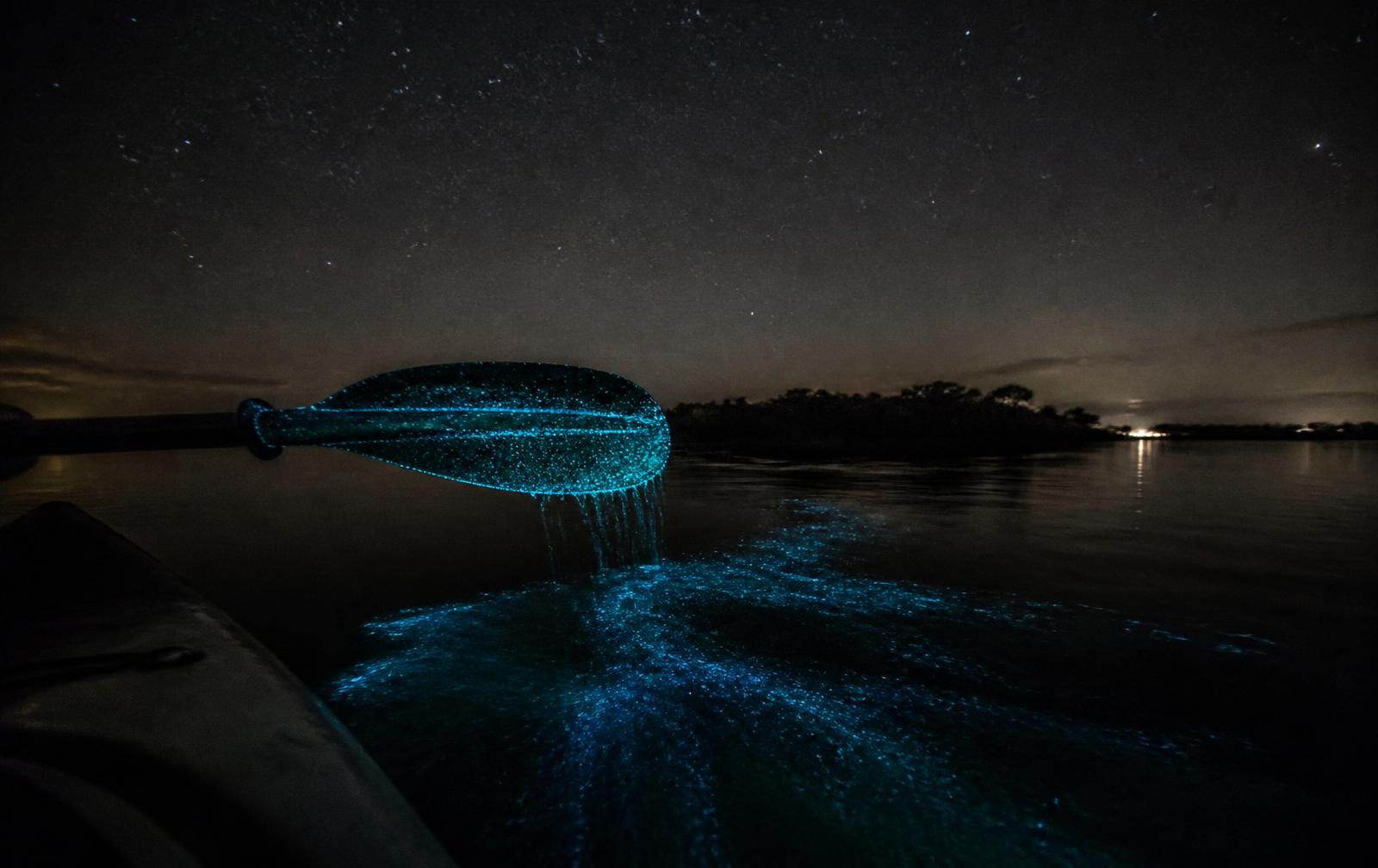
Bioluminescent plankton lighting up a paddle stroke on the Indian River Lagoon — peak season runs roughly June through October.
Quick answers
- When is bioluminescence season in the Indian River Lagoon?
- Roughly June through October for the blue-green plankton glow (dinoflagellates), with July, August and September the most reliable months. From about November through February the glow comes instead from comb jellies, which light up in soft flashes when they are disturbed.
- What moon phase is best for seeing bioluminescence?
- The darkest nights. Aim for the three or four nights either side of a new moon, or go after the moon has set. A bright full moon washes out the glow almost completely, even during peak season.
- Where can you see bioluminescence near Sebastian Inlet?
- The best-known launches are around Haulover Canal and Mosquito Lagoon in the Merritt Island area, about an hour north. Closer in, the dark, shallow, low-traffic water of the Indian River Lagoon around Grant-Valkaria — including off a private dock — can glow well on a calm, moonless night in peak season.
- Do you need a tour to see it?
- No, but a guided kayak or clear-kayak tour is the highest-probability way to see it, because the guides know which stretch is glowing that week. If you have your own kayak or paddleboard you can look for it yourself on any dark night.
- Is bioluminescence harmful or safe to swim in?
- The organism responsible for the summer glow in this lagoon, Pyrodinium bahamense, is associated with saxitoxin, which can accumulate in shellfish. Paddling and hand-dipping are common practice; do not harvest or eat shellfish from the lagoon, and follow current Florida Fish and Wildlife and Florida Department of Health advisories.
The Indian River Lagoon is one of the few places in the United States where the water reliably glows. On the right night you dip a paddle and the blade lights up blue-green; fish shoot away from the kayak as bright streaks; every drop off your hand flashes and dies.
It is not a light show that runs on a schedule, and that is exactly why most visitors miss it. Here is how to actually see it.
What is glowing
There are two completely different phenomena, in two different seasons.
Summer: dinoflagellates. From roughly June into October the glow comes from *Pyrodinium bahamense*, a single-celled plankton that emits a blue-green flash when the water around it is agitated. Movement is the trigger — a paddle stroke, a hand swept through the water, a mullet spooking off the shallows. Still water looks black.
Winter: comb jellies. From roughly November through February the plankton fade and comb jellies (ctenophores) take over. These are palm-sized, transparent, and glow in slower, softer pulses rather than sharp sparks. Many locals prefer them: cooler nights, no mosquitoes, and you can often see the animal itself lit up in your hand.
| Season | Source | Look | Best months |
|---|---|---|---|
| Summer | Dinoflagellates (*Pyrodinium bahamense*) | Sharp blue-green sparks on movement | July – September |
| Winter | Comb jellies (ctenophores) | Slow, soft glowing pulses | December – January |
The three conditions that decide your night
Nearly every disappointed trip fails one of these.
1. Darkness. This matters more than anything else. Plan around the new moon — the three or four nights either side — or go late enough that the moon has already set. A full moon will erase the effect even in the middle of peak season. Give your eyes 15–20 minutes to adjust and keep phone screens off.
2. Calm, warm water. Light wind means glassy water, which means you can see the glow instead of chop. Warm late-summer water concentrates the plankton.
3. Recent reports. The bloom moves. A stretch that lit up brilliantly last week can be flat tonight. Check with tour operators or local paddling groups the same day.
Where to go
The famous launches — about an hour north
The strongest and most consistent displays in this region are in the Merritt Island / Mosquito Lagoon area, especially around Haulover Canal. It is dark, protected, and it is where the commercial tours run. From Grant-Valkaria it is roughly an hour's drive north.
Established operators in that area include BK Adventure and A Day Away Kayak Tours. Both run clear-kayak and standard-kayak night trips through the season and both book out weeks ahead in July and August — reserve early.
Closer to home — the Grant-Valkaria stretch
The lagoon in front of Grant-Valkaria has three things going for it: very little light pollution on the west shore, shallow warm water, and almost no night boat traffic. It is not as consistently bright as Haulover, but on a calm moonless night in August it can glow well — and you can check it in two minutes instead of driving two hours round trip.
If you are staying at Sunrise on the River, the simplest version of this trip is: walk out on the dock after dark, put a hand in the water, and sweep it. If it sparks, take the kayaks out. No launch, no drive, no parking.
How to look for it yourself
- · Go out after full dark — not at dusk. Late enough that no glow is left in the western sky.
- · Kill all white light. Use a red headlamp only, and only when necessary.
- · Sit still for 15 minutes. Your night vision does most of the work.
- · Agitate the water: sweep a hand, splash the paddle blade, or drag your fingers on a slow drift.
- · Look behind you. The wake off a kayak stern is often the brightest thing on the water.
- · Watch for fish. A spooked mullet leaves a comet trail — often the first thing people notice.
Photographing it
Phones struggle. If you want an image: a camera on a tripod or braced on the deck, the widest aperture you have, ISO 3200–6400, and a 5–15 second exposure while someone stirs the water in frame. Newer phone night modes can catch it if you keep the phone dead still. Accept that what you see with your eyes will beat what you get on the sensor.
Safety and etiquette
- · File a plan: tell someone your launch point and your return time.
- · Carry a white light to show other boats, plus a whistle and a PFD. Florida requires a light for vessels under way at night.
- · Avoid the marked channel and the Intracoastal after dark — you are invisible to a boat on plane.
- · Summer nights mean mosquitoes and no-see-ums. Long sleeves and repellent, no exceptions.
- · Do not harvest or eat shellfish from the lagoon. *Pyrodinium bahamense* is associated with saxitoxin; follow current FWC and Florida Department of Health advisories.
- · Leave the animals alone. Comb jellies are fragile — look, do not keep.
Pairing it with the rest of your day
The bioluminescence trip is a night activity, which makes it easy to stack. A typical August day here: run the boat out to the Sebastian Inlet sandbar in the morning while the water is flat, fish the tide change in the late afternoon, eat, then paddle after dark. Check the live inlet cam and tide table before you commit to the morning run.
Boat and kayak launches near the house
Tap a launch to move the map. Drive times are from Sunrise on the River in Grant-Valkaria.
US-1 at Grant, Grant-Valkaria — Closest launch to the house. One concrete lane, boarding dock, straight into the lagoon with no bridges to Sebastian Inlet.
- Drive to Grant Boat Ramp at that hour: 4 min each way (15 min to unload and rig).
- On the water about 7:19 am, back home around 9:23 am.
- Total trip: 2.4 hours.
- Best departure for flat water and light traffic: 6:00 am — the lagoon is usually glass until about 10am.
| Launch | Drive | Fee | Route |
|---|---|---|---|
| 3 min · 1.2 mi | Free | Directions | |
| 5 min · 2.0 mi | Free | Directions | |
| 6 min · 2.0 mi | Free | Directions | |
| 18 min · 11 mi | Free | Directions | |
| 22 min · 14 mi | Free | Directions | |
| 22 min · 14 mi | $4–$5 per vehicle | Directions | |
| 20 min · 12 mi | $8 per vehicle | Directions | |
| 25 min · 17 mi | Free | Directions |
Three ways to stay and paddle
Kayaks are included with every stay at Sunrise on the River, launched from our own dock on the Indian River Lagoon — no rental counter, no trailer, no drive.
Sunrise Paddle Weekend
- · Kayaks included — launch straight off the private dock
- · Paddleboard-flat water from first light to about 10am
- · Fire pit and gazebo for the evening
Lagoon & Spoil Islands Week
- · Kayaks all week, no rental fees
- · Paddle the spoil islands and the Sebastian sandbar
- · Boat ramps under 2 miles for your own trailer
Snowbird Paddle Month
- · Kayaks, dock and screened porch for the whole stay
- · Manatee season on Turkey Creek and the St. Sebastian River
- · Two dogs welcome — $100 per dog per stay
Cleaning $150, dogs $100 each per stay, no resort fees. Check live availability.
Frequently asked
When is bioluminescence season in the Indian River Lagoon?
Roughly June through October for the blue-green dinoflagellate glow, peaking in July, August and September. From about November through February comb jellies produce a softer glow instead.
What is the best moon phase for bioluminescence?
The new moon, or any night after the moon has set. Darkness is the single biggest factor — a full moon washes the glow out even at peak season.
Can you see bioluminescence from a dock?
Yes, on a calm, dark night during peak season. Sweep a hand through the water off the dock; if it sparks, the bloom is present. It is the fastest way to check conditions before committing to a paddle.
Do I need a guided tour?
No, but tours have the highest success rate because guides know which stretch of lagoon is glowing that week. Clear-kayak tours around Haulover Canal, about an hour north of Grant-Valkaria, book out weeks in advance in July and August.
Is the glowing water dangerous?
Paddling and touching the water are common practice. However, Pyrodinium bahamense is associated with saxitoxin, which accumulates in shellfish, so do not harvest or eat shellfish from the lagoon and follow current FWC and Florida Department of Health advisories.
What should I bring on a night paddle?
A PFD, a white light visible to other boats, a whistle, a red headlamp, insect repellent, long sleeves, water, and a phone in a dry bag. Tell someone your launch point and expected return.
The river, once a month
Fishing report, rocket launch dates, sandbar and manatee season, local events — plus the open dates we'd love to fill. One email a month, no spam.
One email a month. Unsubscribe any time — we never share your address.