
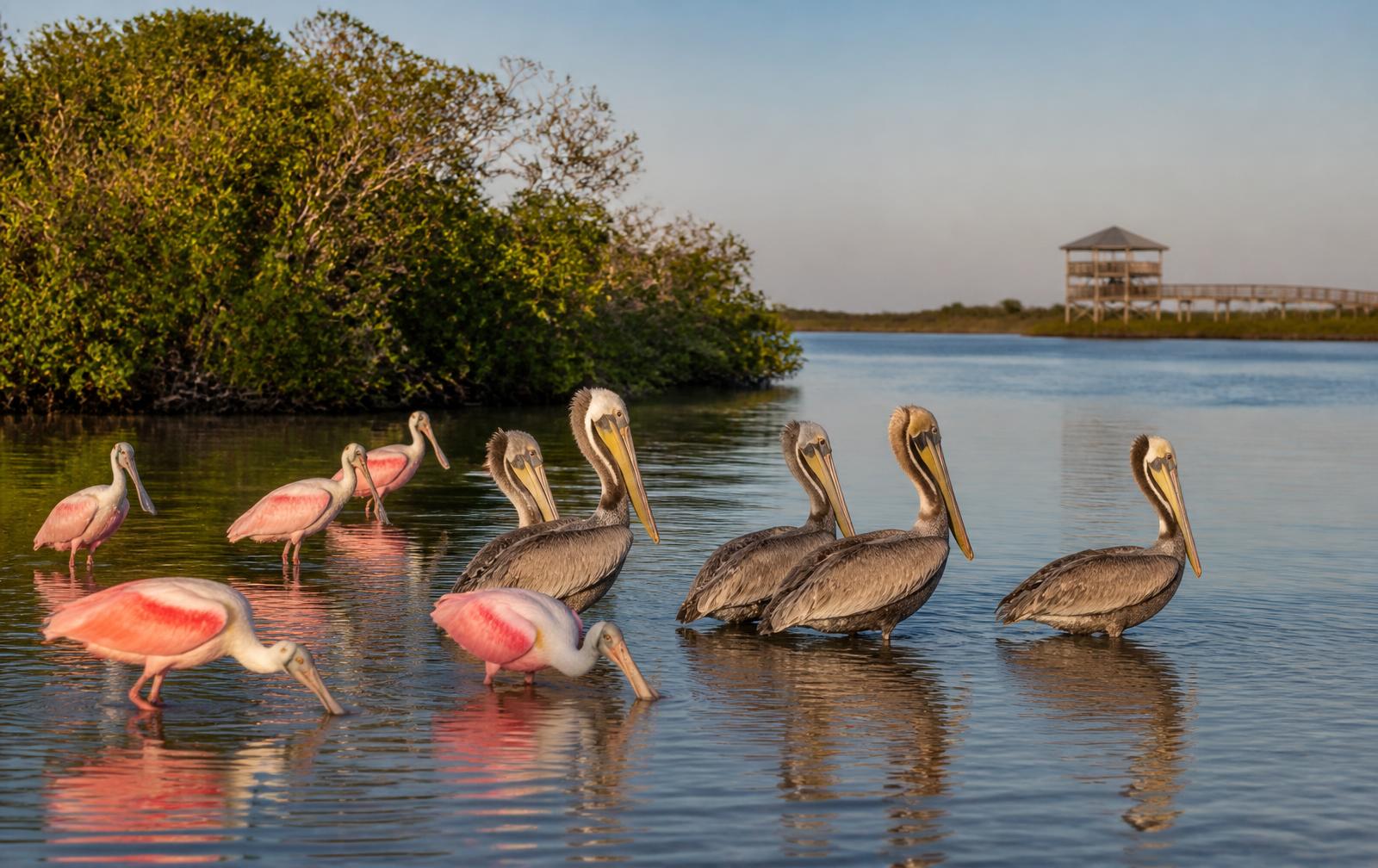
Brown pelicans and roseate spoonbills on the flats near Pelican Island — the island itself is closed to landing, but the surrounding water and the mainland boardwalk are open.
Quick answers
- What is Pelican Island National Wildlife Refuge?
- It is the first national wildlife refuge in the United States, established by executive order of President Theodore Roosevelt on March 14, 1903, to stop plume hunters from wiping out the brown pelican and wading-bird rookeries on a small mangrove island in the Indian River Lagoon. The refuge now protects the island plus thousands of acres of surrounding lagoon, spoil islands and mainland habitat in Indian River County, Florida.
- Can you land on Pelican Island?
- No. The island itself and the water immediately around it are closed to landing and to entry year-round to protect nesting birds. You can view it from the water at a distance, from a boat outside the posted closure markers, or from the mainland observation tower at the end of the Centennial Trail boardwalk.
- How do you visit Pelican Island refuge for free?
- Drive to the mainland trailhead off A1A on the north end of Orchid Island, park free, and walk the Centennial Trail boardwalk about a quarter mile to the observation tower that looks west across the lagoon at the island. Trails are open sunrise to sunset with no entry fee.
- How far is Pelican Island from Grant-Valkaria?
- About 20 miles south by water down the Indian River Lagoon, or roughly a 40-minute drive to the mainland boardwalk trailhead. From a private dock in Grant-Valkaria it is a comfortable half-day boat trip with a stop at the Sebastian spoil islands on the way.
- What is the best time of year to see birds at Pelican Island?
- December through April. Wading-bird nesting peaks in late winter and spring, migratory ducks and shorebirds are present in the cooler months, and the light and mosquito levels are both far better than in midsummer. Early morning is best on any date.
Most people driving A1A between Sebastian and Vero Beach have no idea they are passing the birthplace of the entire American conservation system. There is no gate, no gift shop, and no big brown sign with a bison on it. There is a small parking area, a boardwalk through the scrub, and a wooden tower that looks out over a flat green mangrove island a mile offshore.
That island is Pelican Island. On March 14, 1903, President Theodore Roosevelt signed an executive order making it the first federal bird reservation in the United States — the seed of what is now a system of more than 560 national wildlife refuges. Everything came from a three-acre mudflat in the Indian River Lagoon.
Why the island mattered enough to protect
In the late 1800s, plume hunters were killing wading birds by the tens of thousands to supply the millinery trade. Egret and heron feathers were worth more per ounce than gold. Rookeries up and down the Florida coast were shot out in single seasons.
Pelican Island was one of the last brown pelican rookeries left on Florida's east coast. A German immigrant boat-builder named Paul Kroegel, who lived on the mainland at Sebastian and could see the island from his home, started standing guard over it with a shotgun on his own initiative. Members of the Florida Audubon Society and the American Ornithologists' Union lobbied Washington on the island's behalf, and Roosevelt — himself a serious birder — issued the order. Kroegel became the first federal refuge warden, paid a dollar a month.
The refuge's origin is not an abstraction. Kroegel's descendants still live in the area, and Sebastian's riverfront names, streets and museum exhibits trace directly back to that story.
What is actually protected today
The refuge is much larger than the original island:
| Element | Detail |
|---|---|
| Original island | Roughly 3 acres of mangrove — the historic rookery, closed to entry |
| Total refuge | Approximately 5,400 acres of lagoon, spoil islands and mainland habitat |
| Established | March 14, 1903, by executive order |
| Designations | National Historic Landmark; part of a Wetland of International Importance |
| Managed by | U.S. Fish and Wildlife Service |
| Entry fee | None |
Sixteen-plus species have nested on or around the island historically, including brown pelican, wood stork, roseate spoonbill, great and snowy egret, tricolored heron, little blue heron, black-crowned night heron, double-crested cormorant and white ibis.
The rule everybody gets wrong: you cannot land on it
This is the single most important practical fact. Pelican Island itself is closed to public entry, and the water within the posted closure zone around it is closed too. No landing, no wading, no beaching a kayak "just for a minute." Nesting colonies abandon eggs and chicks when disturbed, and a single close approach during nesting season can wipe out a season's production for dozens of pairs.
What you *can* do:
- · View the island from a boat outside the posted signs and markers, using binoculars or a long lens.
- · Walk the mainland refuge trails and climb the observation tower.
- · Paddle the open lagoon and the nearby spoil islands, keeping well clear of the closure area and of any island with visible nesting activity.
Rangers do patrol. More to the point, the birds are the reason the place exists.
Visiting from land: the Centennial Trail
The public access point is on the barrier island, off A1A on the north end of Orchid Island, south of the Sebastian Inlet.
- · Centennial Trail — a boardwalk roughly a quarter mile long, ending at a two-story observation tower with a view west across the lagoon to the island. Along the boardwalk, planks are engraved with the name and establishment date of every national wildlife refuge in the system, in order. Walking it is a timeline of American conservation.
- · Joe Michael Memorial Trail — a short loop through coastal scrub and hammock, good for warblers and gnatcatchers in migration.
- · Hours — sunrise to sunset, daily.
- · Cost — free.
- · Facilities — parking and interpretive panels. Bring your own water; there is very little shade.
- · Bring — binoculars (essential; the island is a distance off), bug spray from May through October, and a hat.
Realistic expectations
From the tower, the island reads as a low green mound with birds working the flats in front of it. You will not see chicks in a nest. What you will see, on a good winter morning, is pelicans streaming in and out, spoonbills and egrets on the near flats, and often dolphins rolling in the channel. It is a 45-minute stop that rewards patience, not a theme-park experience.
Visiting by water from Grant-Valkaria
From a private dock in Grant-Valkaria, Pelican Island is roughly 20 miles south down the Indian River Lagoon. It makes a genuine half-day or full-day boat trip:
- · Run south inside the lagoon past Micco and Sebastian, staying in the marked channel — the lagoon is broad and shallow, and much of what looks like open water is knee-deep at low tide.
- · Stop at the Sebastian spoil islands on the way; several are open for day use and shelling.
- · Approach the refuge area at idle. Watch for the closure signage and give it a wide berth.
- · Keep an eye on wind: an afternoon east wind stacks a short, hard chop across the open stretches, and the ride home gets long.
By kayak, do not attempt it from Grant — it is far too far. Launch instead from a put-in closer to Wabasso or Sebastian and paddle the near lagoon, or take a guided refuge paddle tour.
Tide, wind and timing
The lagoon here is not strongly tidal, but wind-driven water level matters more than the tide chart. Plan mornings: wind is usually lightest before 10 a.m., the light is behind you looking west at the island, and bird activity peaks early. If you are combining the trip with an inlet run, check the inlet conditions before you commit.
Best months, and what you will see
| Season | What is happening |
|---|---|
| December – February | Peak migratory waterfowl; wading-bird nesting begins; cool, low-bug, best visibility |
| March – April | Nesting activity high; spoonbills at their pinkest; ideal weather |
| May – July | Chicks fledging; hot, buggy, afternoon thunderstorms; boat trips need early starts |
| August – November | Quieter island, strong shorebird migration in fall; hurricane season awareness |
How Pelican Island fits with the rest of the lagoon
The refuge is one piece of a much bigger estuary. If you are building a trip around lagoon wildlife, pair it with:
- · [Bioluminescence in the Indian River Lagoon](/blog/bioluminescence-indian-river-lagoon-guide) — glowing water on dark summer nights.
- · [Secrets of the spoil islands and VIP Island](/blog/secrets-of-indian-river-lagoon-spoil-islands-vip-island) — the man-made islands you *can* land on, and their strange history.
- · [Manatees and wildlife](/area-guide/manatees-and-wildlife) — where to reliably find manatees near Grant-Valkaria.
- · [Sebastian Inlet State Park](/blog/sebastian-inlet-state-park-guide) — the jetties, the campground and the ocean side.
Staying nearby
We host at Sunrise on the River in Grant-Valkaria, directly on the Indian River Lagoon about 20 miles north of the refuge by water. Guests who come for birds tend to do the same thing: coffee on the dock at first light with binoculars, a run south by boat or a drive to the boardwalk mid-morning, and back for the sunset over the water. There is a private dock for your own boat, kayaks to use, and boat ramps within 1.2 miles if you are trailering.
Boat and kayak launches near the house
Tap a launch to move the map. Drive times are from Sunrise on the River in Grant-Valkaria.
US-1 at Grant, Grant-Valkaria — Closest launch to the house. One concrete lane, boarding dock, straight into the lagoon with no bridges to Sebastian Inlet.
- Drive to Grant Boat Ramp at that hour: 4 min each way (15 min to unload and rig).
- On the water about 7:19 am, back home around 9:23 am.
- Total trip: 2.4 hours.
- Best departure for flat water and light traffic: 6:00 am — the lagoon is usually glass until about 10am.
| Launch | Drive | Fee | Route |
|---|---|---|---|
| 3 min · 1.2 mi | Free | Directions | |
| 5 min · 2.0 mi | Free | Directions | |
| 6 min · 2.0 mi | Free | Directions | |
| 18 min · 11 mi | Free | Directions | |
| 22 min · 14 mi | Free | Directions | |
| 22 min · 14 mi | $4–$5 per vehicle | Directions | |
| 20 min · 12 mi | $8 per vehicle | Directions | |
| 25 min · 17 mi | Free | Directions |
Three ways to stay and paddle
Kayaks are included with every stay at Sunrise on the River, launched from our own dock on the Indian River Lagoon — no rental counter, no trailer, no drive.
Sunrise Paddle Weekend
- · Kayaks included — launch straight off the private dock
- · Paddleboard-flat water from first light to about 10am
- · Fire pit and gazebo for the evening
Lagoon & Spoil Islands Week
- · Kayaks all week, no rental fees
- · Paddle the spoil islands and the Sebastian sandbar
- · Boat ramps under 2 miles for your own trailer
Snowbird Paddle Month
- · Kayaks, dock and screened porch for the whole stay
- · Manatee season on Turkey Creek and the St. Sebastian River
- · Two dogs welcome — $100 per dog per stay
Cleaning $150, dogs $100 each per stay, no resort fees. Check live availability.
Frequently asked
Is Pelican Island National Wildlife Refuge open to the public?
The mainland trails — the Centennial Trail boardwalk and the Joe Michael Memorial Trail — are open to the public daily from sunrise to sunset with no entry fee. The island itself and the closure zone in the water around it are closed to entry year-round to protect nesting birds.
Where do you park to visit Pelican Island refuge?
At the refuge trailhead parking area off A1A on the north end of Orchid Island, south of Sebastian Inlet, in Indian River County. Parking is free, and the boardwalk to the observation tower starts there.
Do you need a boat to see Pelican Island?
No. The mainland observation tower at the end of the Centennial Trail boardwalk gives a clear view west across the lagoon to the island. Binoculars are strongly recommended. A boat gets you closer to the surrounding flats, but you still cannot enter the posted closure zone.
Why is Pelican Island historically important?
It was the first federal bird reservation in the United States, protected by Theodore Roosevelt in 1903 after plume hunters had destroyed most of Florida's wading-bird rookeries. It became the first unit of what is now the National Wildlife Refuge System, and it is a designated National Historic Landmark.
Can you kayak at Pelican Island National Wildlife Refuge?
Yes, in the open lagoon and around nearby spoil islands, but not inside the posted closure zone around Pelican Island itself. Launch from a put-in near Sebastian or Wabasso rather than paddling down from Grant-Valkaria, which is roughly 20 miles away.
Are dogs allowed at Pelican Island refuge?
Dogs are restricted on national wildlife refuge trails and are not appropriate near nesting bird habitat. Plan a dog walk elsewhere — Brevard County's designated dog beach at Canova Beach or the quiet neighbourhood streets near Grant-Valkaria are better options — and check current refuge rules before you go.
The river, once a month
Fishing report, rocket launch dates, sandbar and manatee season, local events — plus the open dates we'd love to fill. One email a month, no spam.
One email a month. Unsubscribe any time — we never share your address.